
-
Date
Wednesday, April 15 2026
-
Time
6:00pm - 8:00pm
-
Location
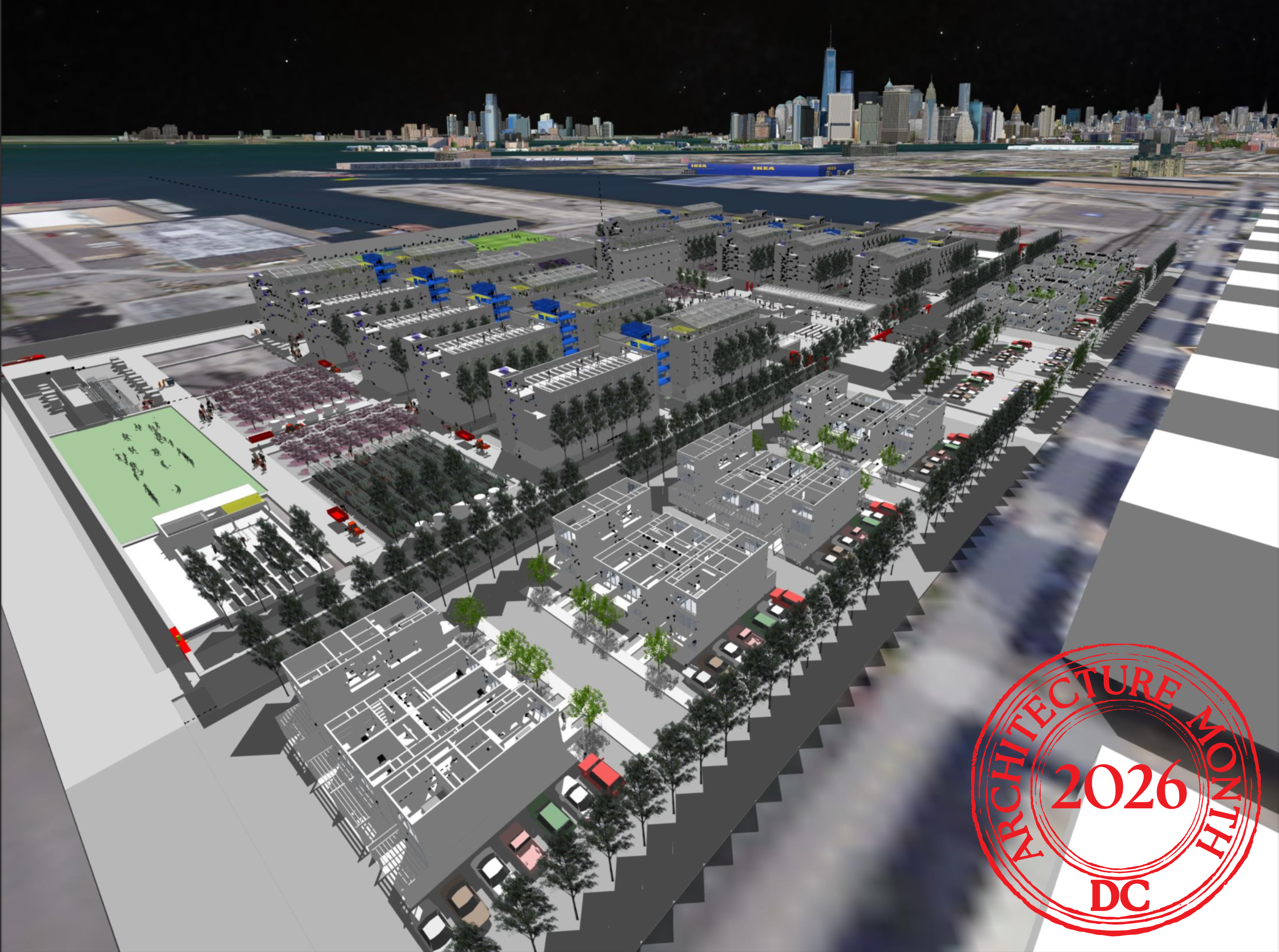
Graphics by Stanley Hallet, FAIA
Rehab City challenges the very premise of the traditional correctional facility, proposing a new architectural model where every square foot of building and landscape is designed to prepare residents for a successful return to civil society. In this 20-minute presentation followed by open discussion, architect Stanley Hallet introduces a comprehensive vision for a restorative justice campus that redefines the relationship between security, dignity, and opportunity. Internationally presented at the International Corrections and Prisons Association (ICPA) and nationally at the American Correctional Association (ACA), the project has sparked dialogue among correctional leaders and policymakers.
At its core, Rehab City replaces large, impersonal cell blocks with small-scale residential floors of 14 single rooms, fostering safety, community, and accountability. Advanced technology streamlines operations, reducing time spent on manual counts and increasing time available for education, vocational training, and reentry preparation. Sustainable systems, including solar energy and integrated food production, create both environmental responsibility and economic efficiency.
The campus model extends beyond housing to include agricultural production, on-site restaurants, a token-based work economy, and meaningful job training that builds real-world skills. A secure but separate hotel supports family reunification, transforming visitation into a normalized and restorative experience. A central “Main Street” brings essential services—such as employment assistance, social services, and community organizations—onto the campus, embedding reentry support into daily life rather than postponing it until release.
Rehab City offers a bold, hopeful alternative to conventional prison design—one that aligns architecture, operations, and social purpose in pursuit of reduced recidivism and safer communities.
Presented by:
Stanley Ira Hallet, FAIA, is Former Dean of the School of Architecture and Planning at The Catholic University of America (CUA) in Washington, DC, and Professor Emeritus of Architecture. Over a distinguished academic career spanning more than four decades, he taught undergraduate and graduate studios exploring the relationships between culture, urban design, landscape, and architecture. His international experience includes service as a Peace Corps Volunteer in Tunisia and a Fulbright-Hayes Lecturer at the University of Kabul, as well as leading architecture programs in Rome, Paris, and at the Université Tunis Carthage.
Hallet has lectured widely in the United States and Europe and published in major architectural journals. He is the co-author of The Traditional Architecture of Afghanistan and has produced documentary films with his wife, filmmaker Judith Dwan Hallet, including The Tale of the Tongs, which premiered at the Environmental Film Festival in the Nation’s Capital. His recent work focuses on alternative models of incarceration, presented internationally through his project Rehab City.
A Fellow of the American Institute of Architects, Hallet has received 12 AIA design awards, the AIA-DC Centennial Award (2022), and the 2023 Architect of the Year award from the DC Council of Engineering and Architectural Societies. He holds both a Bachelor and Master of Architecture from the Massachusetts Institute of Technology and has served on numerous academic and professional design juries worldwide.
Learning Objectives:
- Evaluate architectural, urban, and landscape design alternatives to traditional incarceration models, and assess how these approaches can improve occupant safety, rehabilitation outcomes, and community welfare.
- Analyze how the integration of work, education, and therapeutic spaces within correctional environments can support mental health, skill development, and successful reentry, while maintaining life safety and operational security.
- Examine how on-site agriculture, food preparation, and mentor-led restaurant programs can contribute to occupant health, nutritional well-being, vocational training, and reduced institutional violence.
- Identify design considerations for extending rehabilitative correctional models to women with children and juveniles, including safety, developmental needs, trauma-informed environments, and family reunification support.