
-
Date
Thursday, December 10 2026
-
Time
12:00pm - 1:00pm
-
Location
Zoom
This Book Talk is a production of the AIA Committee on the Environment (a Knowledge Community) in partnership with the AIA Historic Resources Committee (a Knowledge Community).
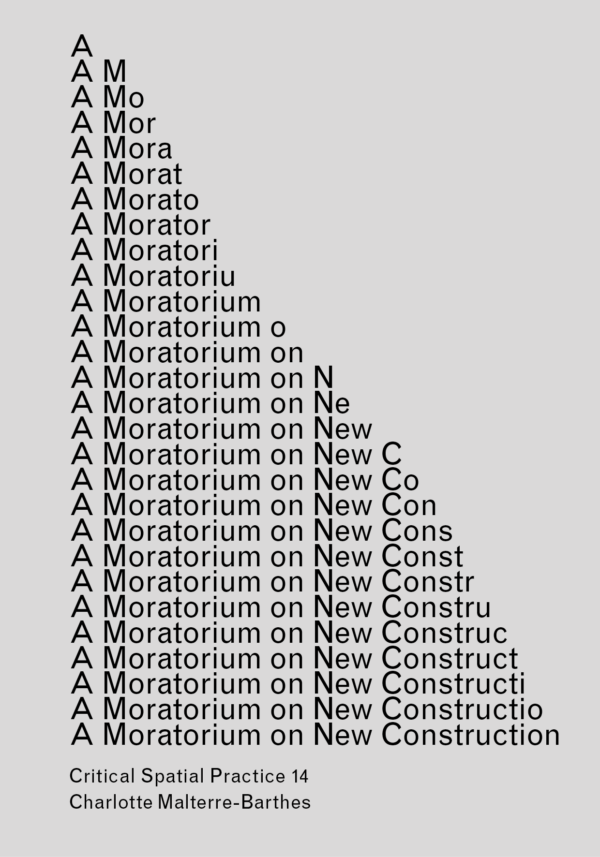
To pause new construction, even briefly, spurs a radical thinking framework for alternatives to the current approach to space production and its growth imperative. This is the idea that Charlotte Malterre-Barthes explores in A Moratorium on New Construction (Sternberg Press, 2025). The book envisions a value shift for our existing stock. This COTE Book Talk starts with Malterre-Barthes unpacking these ideas and leads into a discussion between her and Arathi Gowda, FAIA, who reviews the book for COTE. Together, they will consider the compelling idea of a pause on new construction.
Such a pause, even briefly, as the publisher website notes: “creates a radical thinking framework for alternatives to the current regime of space production and its suspect growth imperative. Engaging with unsettling questions, A Moratorium on New Construction envisions a massive value shift for our existing stock. From housing redistribution to reinviting value generation, from anti-extractive measures to profound structural changes, from curricula reforms to purging the exploitative culture of the office, an entire rewiring of design processes and construction lies ahead. Somewhere between a thought experiment and a call for action, A Moratorium on New Construction is a leap of faith to envision a less extractive future, made of what we have: "Not demolishing, not building new, but building less, building with what exists, inhabiting it differently, and caring for it.”
COTE and HRC appreciate the collaboration and support of the AIA DC COTE group, the AIA DC Chapter, and Quinn Evans.
1 CE/LU HSW for this session will be offered.
Learning Objective 1
Identify the environmental, human, and ecological impacts of extractive material processes and conventional construction practices, including their effects on climate, land, water, and communities.
Learning Objective 2
Examine strategies for reducing the environmental impacts of new construction by prioritizing the preservation, reuse, adaptation, and more intensive inhabitation of existing buildings and housing stock.
Learning Objective 3
Evaluate how material choices, construction practices, demolition, and building reuse can influence human health, environmental quality, and the long-term welfare of communities and ecosystems.
Learning Objective 4
Apply resource-conscious design strategies that support housing needs while reducing reliance on new material extraction and construction, including adaptive reuse, redistribution of existing housing resources, and design approaches centered on maintaining and caring for existing buildings.
Presented By:

Photo Credit: Juliette Paulet
Charlotte Malterre-Barthes - Author
Charlotte Malterre-Barthes is an architect, urban designer, and Assistant Professor at EPFL, leading the RIOT laboratory. Her research examines contemporary urbanization, material extraction, climate and social emergency. While Assistant professor at Harvard, she initiated "A Moratorium on New Construction," challenging development protocols (2025, Sternberg/MIT Press). She holds a PhD (ETH Zurich) on space and political economy of commodities, and co-founded the Parity Group (Meret Oppenheim Prize 2023) and the Parity Front, activist networks advocating for equality in architecture.

Arathi Gowda, FAIA - Reviewer
Arathi Gowda is Perkins&Will’s Northeast Regional Regenerative Design Director and founder of Yes Praxes, created in 2021 to accelerate a just climate transition. She has taught sustainable urbanism at several universities and is an adjunct faculty member at Northwestern University’s Institute for Sustainability and Energy. Arathi champions collective climate action and serves on AIA’s Committee on the Environment Advocacy Group and Government Advocacy Committee. She also co-chairs the climate pledge US Architects Declare.
Sponsored By: